The HTTP of the Agentic Web: Inside the A2A v1.0 Standard and the End of Python's Agent Monopoly
The Google-born and Linux Foundation-hosted Agent-to-Agent (A2A) protocol has officially hit its production-ready v1.0 milestone. Along with Microsoft's newly launched Agent Framework 1.0, this standard provides a universal, cross-language blueprint for multi-agent delegation without brittle, hand-coded integrations.

The HTTP of the Agentic Web: Inside the A2A v1.0 Standard and the End of Python's Agent Monopoly
Until recently, building multi-agent AI pipelines felt like the Wild West. If a data science team built an extraction agent in Python and the security team built a policy validator in Go, getting them to collaborate required writing brittle, custom API wrappers. The industry has suffered from a fragmentation crisis, leaving teams locked into single-language silos and vendor-specific frameworks.
That fragmentation is officially over. The Agent-to-Agent (A2A) Protocol, originally developed by Google and hosted by the Linux Foundation, has officially reached its production-ready v1.0 milestone. Supported by over 150 organizations—including Microsoft, AWS, Salesforce, and IBM—A2A is rapidly becoming the "HTTP of the agentic web," establishing a universal standard for how autonomous systems discover, delegate, and communicate.
What is A2A and How Does It Work?
A2A defines a standard client-server architecture where agents can negotiate tasks across network, runtime, and organizational boundaries. It introduces the concept of the Agent Card, a JSON metadata file served at /.well-known/agent.json (analogous to an OpenAPI specification).
The Agent Card declares:
- Capabilities: What tasks the agent can perform.
- Transports: Support for JSON-RPC 2.0, gRPC, or HTTP/REST.
- Authentication: Strict verification requirements like OAuth 2.0 or mutual TLS (mTLS).
Once authorized, a client agent can dispatch a task, watch its state stream live via Server-Sent Events (SSE), and handle complex human-in-the-loop pauses—allowing a remote task to pause for human approval and resume seamlessly days later.
MCP vs. A2A: Knowing the Difference
A common source of confusion in the developer community is the division of labor between the Model Context Protocol (MCP) and A2A.
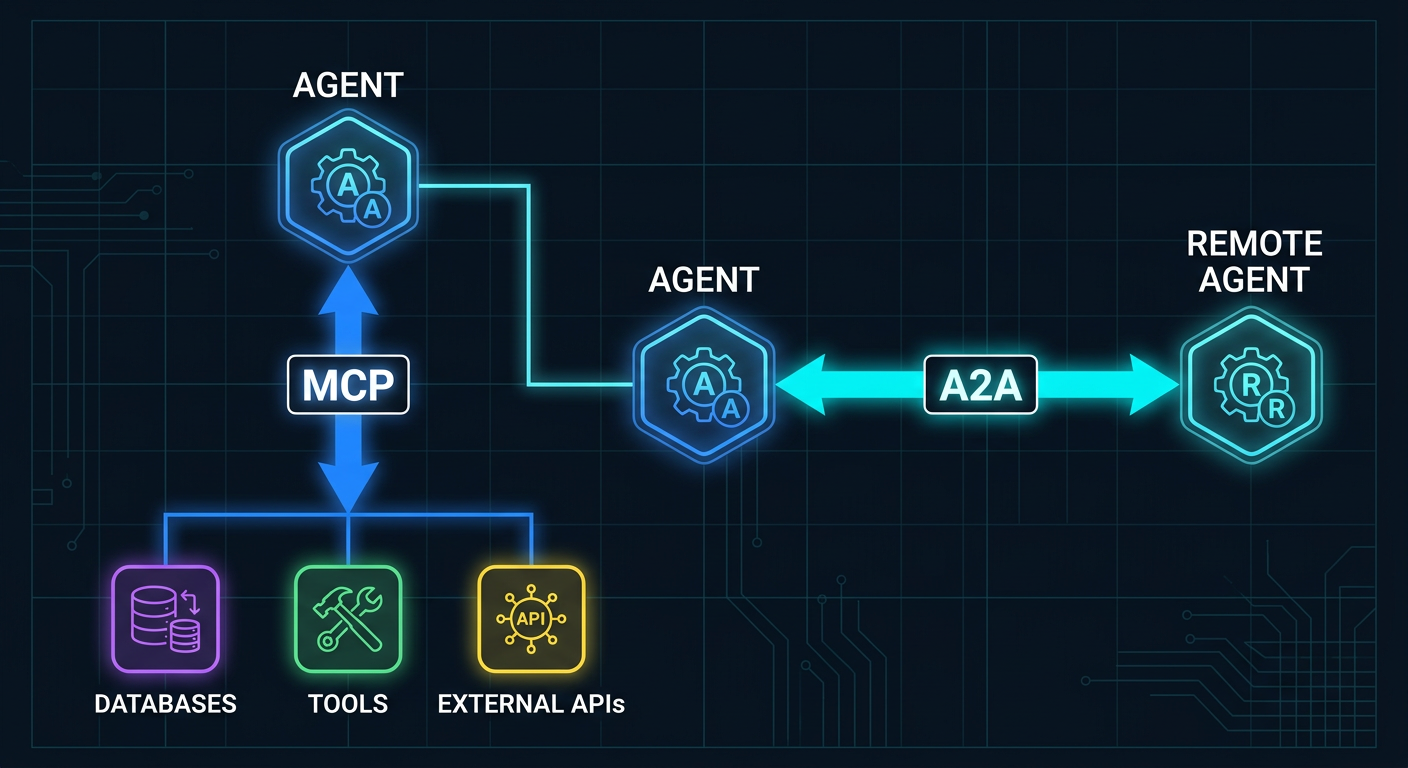
- MCP is internal and vertical: It connects an individual agent to its own tools, local databases, and filesystems.
- A2A is external and horizontal: It allows an agent to treat another agent as an independent actor, delegating tasks without sharing tool access, memory, or prompts.
The consensus production pattern is clear: use MCP vertically to equip your agent with tools, and A2A horizontally to coordinate work between those agents.
Heavyweights Fall in Line: Microsoft and Google ADK
The release of A2A 1.0 coincides with a massive consolidation of enterprise developer frameworks:
- Microsoft Agent Framework 1.0 GA: Launched as the open-source, production-ready successor to AutoGen and Semantic Kernel. It natively integrates A2A and MCP, supporting both Python and C# (.NET) out of the box.
- Google ADK 1.0: Shipped with multi-language SDKs (Python, TypeScript, Java, Go, and Kotlin), demonstrating the first cross-language, contract-compliance pipelines powered entirely by A2A.
By decoupling the agent runtime from the communication layer, A2A v1.0 ensures that your enterprise architecture is future-proof. You can now build, secure, and scale an interconnected mesh of specialized agents across your entire organization, regardless of the frameworks or models powering them.


Get the wire in your inbox
Every new signal, straight from the generator. No noise, unsubscribe anytime.